Featuring insights from AimGlobal’s work with client Amarakosha:
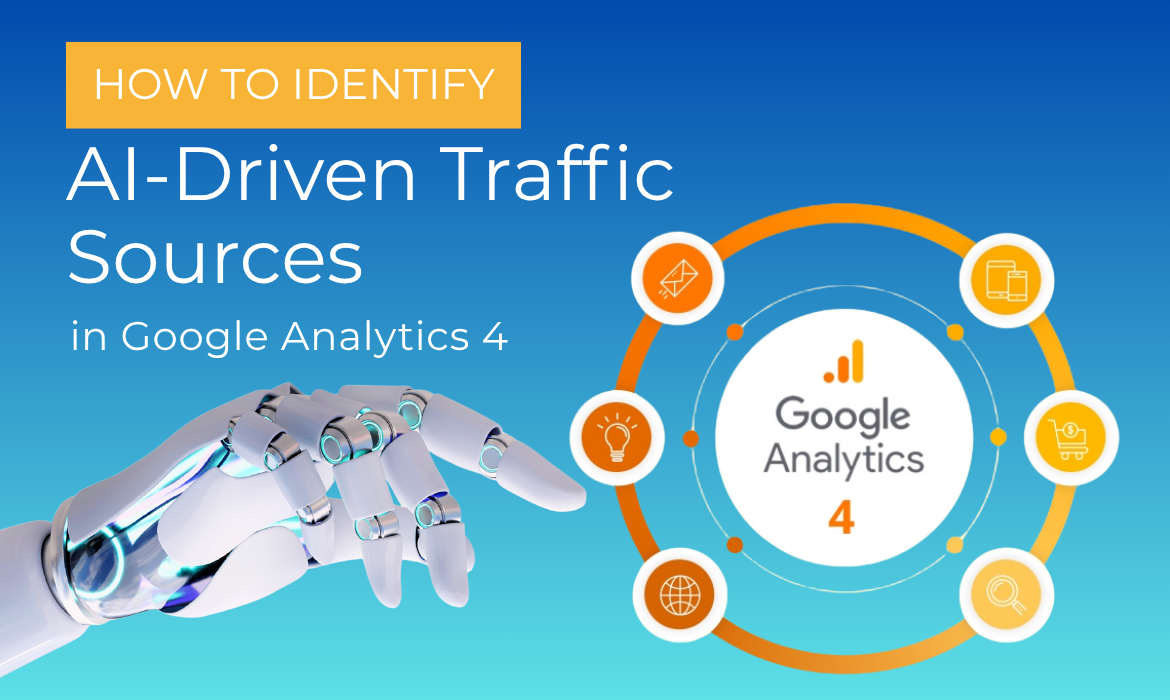
Search behaviour has quietly changed. People aren’t just Googling anymore — they’re asking ChatGPT, Perplexity, and Gemini for recommendations, and then clicking through to your website. If your analytics dashboard hasn’t caught up to this shift, you’re flying blind on one of the fastest-growing acquisition channels of 2026.
Here’s the good news: GA4 already tracks this. You just need to know where to look — and what to do once you find it. To show exactly how this plays out in practice, this article draws on a live GA4 property Aim Global manages for its client Amarakosha — real data, from a real account, showing AI-driven visitors in action.
Why AI Traffic in Google Analytics 4 Deserves Its Own Line Item:
Every AI assistant that sends a user to your site leaves a footprint in GA4’s User Acquisition report, under “First user source/medium.” It looks just like any other referral — a source name plus a medium — except the source is an AI platform instead of a search engine or social network.
This matters because:
- AI-referred visitors often convert differently. They arrive later in the decision journey, already primed by a conversational answer.
- Attribution blind spots cost budget. If you can’t see it, you can’t optimize for it — or credit it in your marketing mix.
- Early movers win the narrative. Brands showing up in AI-generated answers today are shaping tomorrow’s consideration sets.
How to See AI Referrals in GA4 — Step by Step:
- Go to Reports → Acquisition → User acquisition
- Set the primary dimension to First user source/medium.
- Sort by Total users (descending) to surface every source, including smaller ones.
- Scan the list for AI-platform domains.
ChatGPT Traffic in GA4: What It Actually Looks Like
This is where most marketers miss it — because ChatGPT traffic doesn’t show up as “ChatGPT.” It shows up as a source/medium pair, typically:
- chatgpt.com / ai-assistant — visitors who clicked a link inside a ChatGPT conversation.
- chatgpt.com / (not set) — sessions where the referral medium wasn’t captured cleanly, usually due to a redirect or missing UTM.
In Amarakosha’s own GA4 property, covering the June 1 – July 13, 2026 period, chatgpt.com/ai-assistant delivered:
- 114 total users (3.01% of all traffic)
- 113 new users — almost entirely first-time visitors.
- 46 seconds average engagement time, with a 0.84 engaged-sessions-per-user rate — comparable to Instagram social traffic in the same report.
That 3% might look small next to Google’s ~65% combined share. But six months ago, this line item often didn’t exist at all. The trajectory, not the current size, is the story.
Other AI and Emerging Sources to Watch:
- perplexity.ai / referral
- gemini.google.com / referral
- copilot.microsoft.com / referral
- Any “(not set)” rows worth auditing — some AI referral traffic still arrives without clean tagging
Turning This Insight Into Strategy:
Spotting AI traffic in Google Analytics 4 is step one. The real value is in what you do next:
- Tag your content for AI visibility — structured data, clear FAQs, and authoritative answers get cited more often by AI assistants.
- Build source-specific landing experiences — a visitor from ChatGPT has different context than one from a Google ad.
- Track this monthly — AI referral share is currently one of the fastest-moving lines in any GA4 report.
Client Spotlight: Amarakosha — Aim Global Makes AI Traffic Work Harder
This is exactly the kind of insight AimGlobal Digital brings to every client relationship — not just running campaigns, but reading the data other agencies skim past. Amarakosha is a standout example of that approach in action.
When Amarakosha came to AimGlobal, the brief was familiar: strong product, invisible online presence, and a marketing spend that wasn’t translating into footfall or bookings. Aim Global didn’t just tune the usual paid and organic levers. The team dug deep into Amarakosha’s own acquisition-level analytics — the exact GA4 reports covered in this article — to identify where real, high-intent traffic was actually originating, including the newer AI-driven channels most agencies overlook entirely.
That analytical depth, paired with AimGlobal’s SEO, performance marketing, and content expertise, helped Amarakosha capture demand across both traditional and emerging discovery channels — turning a blind spot into a growth lever, with ChatGPT now showing up as a measurable, trackable acquisition source in Amarakosha’s own dashboard.
It’s a pattern AimGlobal has repeated across 100+ clients in India, the Middle East, and the USA — but Amarakosha’s results are the clearest proof point: find the traffic no one else is measuring, then build a strategy around it before competitors notice.
The Bottom Line:
AI-driven traffic isn’t a future trend to prepare for — it’s already sitting in your GA4 reports, waiting to be read correctly. Digital marketing in 2026 belongs to the brands that treat every source/medium row as a signal, not noise.
Want to know how much of your traffic is already coming from AI assistants — and what to do about it?
Book a free GA4 traffic audit with AimGlobal Digital at aimglobal.digital and find out exactly where your next customer is discovering you — before your competitors do.

![𝗖𝗹𝗶𝗰𝗸𝘀 𝗮𝗿𝗲𝗻’𝘁 𝘁𝗵𝗲 𝗴𝗼𝗮𝗹. 𝗖𝘂𝘀𝘁𝗼𝗺𝗲𝗿𝘀 𝗮𝗿𝗲.With the right strategy, performance marketing can turn ad spend into quality leads, conversions and measurable growth.At Aim Global Digital, we manage Meta Ads, Google Ads, lead generation and ROI optimisation to help businesses grow smarter.𝗥𝗲𝗮𝗱𝘆 𝘁𝗼 𝘁𝘂𝗿𝗻 𝘆𝗼𝘂𝗿 𝗮𝗱 𝘀𝗽𝗲𝗻𝗱 𝗶𝗻𝘁𝗼 𝗯𝗲𝘁𝘁𝗲𝗿 𝗿𝗲𝘀𝘂𝗹𝘁𝘀?
🌐 www.aimglobal.digital
📞 +91 87923 81091[Performance Marketing, Meta Ads, Google Ads, Lead Generation, Paid Advertising, ROI Optimisation, Digital Marketing Agency]#performancemarketing #metaads #googleads #leadgeneration #aimglobaldigital](https://aimglobal.digital/wp-content/plugins/instagram-feed/img/placeholder.png)